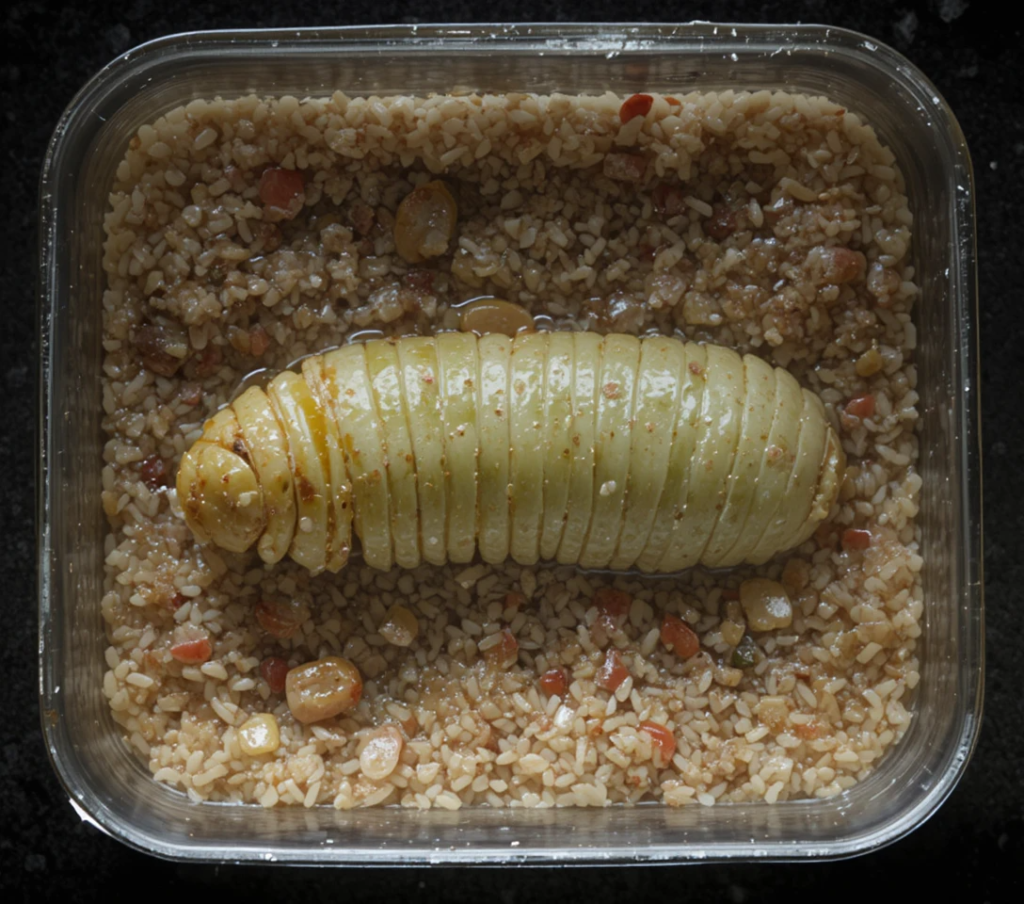
We have a word for what a caterpillar does. We have a word for the change of seasons. But we have no true word for what happens to food after the feast ends. We call it “leftover”—a term that looks backward with regret. But this is not an ending. It is a pupal stage. A quiet, transformative waiting in the dark.
Metamorphosis is the process by which a finished meal, removed from the heat and conversation of the table, begins a second, internal cooking. It is not decay. Decay is an invasion—bacteria breaking down structure toward dissolution. Metamorphosis is an evolution—the food’s own components reorganizing toward a new, often superior, state of being.
The Three Stages of Culinary Metamorphosis
Stage 1: The Great Settling (0–2 Hours Post-Meal)
The heat is gone. The urgent dance of molecules slows. In this new quiet, the dish begins to find its true balance. Fats, once emulsified, rise gently to the surface. Flavors that shouted over each other in the heat begin to converse. The garlic softens its bite. The acid integrates. The dish is not cooling; it is composing itself. This is the meal’s first meditation.
Stage 2: The Nocturnal Consensus (2–12 Hours in Darkness)
In the cold dark of the refrigerator, the most profound work begins. This is not passive storage. It is active negotiation.
Water molecules migrate from areas of abundance to areas of scarcity, seeking equilibrium. Starches recrystallize, not to become “stale,” but to develop structural integrity for their next purpose. Proteins relax further, tenderizing beyond what heat alone could achieve. Spices perform a slow, molecular osmosis, penetrating every component.
The dish is no longer a collection of ingredients following a recipe. It is becoming a unified entity with new, emergent properties. The broth has gelled. The stew has thickened. The rice has dried to perfect fry-able grains. The food is preparing a résumé for its next job.
Stage 3: The Emergence (The Moment of Rediscovery)
When you open the container, you are not looking at old food. You are witnessing an emergence. The metamorphosis is complete. The food now presents you with its new nature:
-
It has clarified itself (separated fats, concentrated flavors).
-
It has changed its texture (firmed, softened, gelled).
-
It has deepened its flavor profile (harmonized, matured).
Your role now shifts from Creator to Interpreter. The food speaks in the silent language of its transformed state. Your job is to listen, and to ask the only question that matters now: “What do you want to become?”
What Metamorphosis Is NOT
To understand metamorphosis, we must clear the confusion:
-
It is NOT “saving leftovers.” That is an act of storage. Metamorphosis is a process of transformation.
-
It is NOT “reheating.” Reheating attempts to reverse time, to force the food back into its past state. Metamorphosis asks you to move forward with the food into its new state.
-
It is NOT “disguising leftovers.” Hiding yesterday’s meal in a casserole is camouflage. Metamorphosis is authentic reinvention—creating something new that honestly incorporates the evolved ingredient.
-
It is NOT “preventing waste.” That is a negative goal (avoiding a bad thing). Metamorphosis is a positive creation (making a new, good thing).
The Signal That Metamorphosis Has Occurred
The food will tell you. Look for:
-
The Offering of Separation: Components have parted ways cleanly (oil on top, solids below), giving you options.
-
The Gift of Concentration: Flavors are more intense, not faded. The soup is more itself.
-
The Change in Physical State: Liquids have gelled. Solids have firmed or softened predictably.
-
The Shift in Aroma: The sharp, hot scent of dinner has mellowed into a deeper, rounder, more complex fragrance.
The Human’s Role: The Midwife of the Second Meal
We are not the authors of this change. We are the facilitators. Our duty is threefold:
-
Provide the Sanctuary: A clean, sealed container. The correct cold. The undisturbed dark.
-
Practice Disciplined Patience: Do not interrupt the process. Let the silent work finish.
-
Recognize the Moment of Readiness and act not with force, but with collaborative creativity.
When you take morphed, day-old stew and turn it into a pot pie, you did not “use leftovers.” You provided a new form for a substance that had already transformed. You completed the cycle.
The Final Lesson of the Empty Container
The true end of metamorphosis is not the second meal. It is the clean, empty container.
That washed container represents a journey fully honored: from raw ingredient to first creation, through silent transformation, to second creation, to complete, grateful consumption. Nothing was wasted because nothing was ever seen as “waste.” It was all seen as a phase in a continuous cycle of becoming.
Metamorphosis, therefore, is the kitchen’s most humble and profound wisdom. It is the practice of seeing time not as the enemy of food, but as its most subtle and sophisticated ingredient. It is the faith that a meal is never truly over—it is only ever waiting for us to understand what it has, quietly and intelligently, decided to be next.