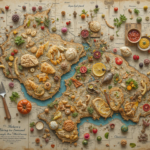
Every refrigerator contains unexplored territories, every leftover a potential discovery waiting to be mapped. Welcome to gastrography—the discipline that applies the principles of cartography, exploration, and navigation to the world of food transformation. Your kitchen isn’t just a room; it’s an uncharted continent, your leftovers are its unexplored regions, and tonight, you become its cartographer.
Consider this: 80% of the world’s oceans remain unmapped, and similarly, 85% of leftover transformation possibilities go unexplored in American kitchens. We throw away what we don’t understand, discard what we haven’t charted. Gastrography changes this by providing the tools to map your flavors, navigate your ingredients, and chart courses to delicious destinations you didn’t know existed.
Establishing Your Coordinates
The Foundational Grid System
Every map begins with coordinates. Your kitchen needs the same orientation system.
The Flavor Longitude:
Running from Sweet (0°) to Savory (180°)
-
Sweet (0-45°): Fruits, sugars, certain vegetables
-
Bright (45-90°): Citrus, vinegar, fresh herbs
-
Earthy (90-135°): Mushrooms, root vegetables, beans
-
Savory (135-180°): Meats, cheeses, umami ingredients
The Texture Latitude:
Running from Crisp (90°N) to Creamy (90°S)
-
Crisp (90-45°N): Raw vegetables, crackers, chips
-
Chewy (45°N-0°): Breads, certain meats, dried fruits
-
Tender (0-45°S): Cooked vegetables, fish, pasta
-
Creamy (45-90°S): Mashed potatoes, sauces, avocado
The Temperature Altitude:
-
High Altitude (Hot): 160°F+
-
Mid-Altitude (Warm): 100-160°F
-
Sea Level (Room Temp): 65-85°F
-
Below Sea Level (Cold): 40°F and below
The Cartographer’s Toolkit
Essential Mapping Equipment
The Surveying Tools:
-
Compass: Your palate, always pointing toward balance
-
Sextant: A thermometer, measuring heat angles
-
Chronometer: Timer, tracking cooking durations
-
Theodolite: Scale, measuring ingredient proportions
The Recording Instruments:
-
Field Notes: Kitchen journal for observations
-
Sketch Pad: Plates as your drawing surfaces
-
Photographic Equipment: Camera for documentation
-
Sampling Containers: Small bowls for taste testing
The Navigation Aids:
-
Star Charts: Recipe books as celestial guides
-
Tide Tables: Seasonal ingredient availability charts
-
Current Maps: Flavor trend observations
-
Depth Sounders: Texture assessment tools
The Initial Survey
Mapping Your Existing Territory
Aerial Survey
Opening the refrigerator door and observing without touching
-
Visual topography: Color variations, texture landscapes
-
Container cartography: Identifying “cities” (main dishes) and “towns” (side dishes)
-
Age stratification: Geological layers of food history
The Ground Expedition
Physical examination of territories
-
Texture terrain analysis: Mountains (solid), valleys (liquid), plains (mixed)
-
Aroma climate zones: Tropical (spicy), temperate (herbal), arid (dry)
-
Flavor watersheds: Sources and flows of dominant tastes
Resource Assessment
-
Mineral deposits: Salts, spices, crystalline sugars
-
Water sources: Broths, sauces, liquid components
-
Vegetation: Fresh, cooked, or preserved plant matter
-
Fauna: Animal proteins in various states
Charting Transformation Routes
From Map to Journey
The Direct Path
Shortest distance between two points
Example: Leftover chicken → Chicken salad
Navigation: Minimal additional ingredients, simple preparation
The Scenic Route
Longer journey with intentional detours
Example: Leftover vegetables → Vegetable fritters → Fritter sandwich → Fritter croutons for soup
Navigation: Multiple transformations, creative additions
The Expedition
Major journey into unknown territory
Example: Mystery leftovers → Deconstruction → Component analysis → Complete reinvention
Navigation: Experimental, high-risk, high-reward
The Trade Route
Combining multiple territories
Example: Leftovers from three different meals → Fusion dish
Navigation: Diplomatic flavor negotiations, cultural blending
The Gastrographic Legends
Understanding Your Map Symbols
Geological Symbols:
-
∆ Mountain: Protein-dominant dish
-
≈ River: Sauce or liquid component
-
◯ Lake: Self-contained single item
-
// Plains: Mixed components without hierarchy
Cultural Markers:
-
† Church: Holiday or special occasion food
-
🏠 House: Family staple or frequently made dish
-
⚓ Anchor: Restaurant leftovers
-
✈ Airport: Travel-inspired foods
Resource Indicators:
-
$ Gold: High-value ingredients
-
⛽ Fuel: Energy-dense foods
-
💧 Water: Hydrating components
-
🌱 Green: Plant-based items
Hazard Warnings:
-
! Cliff: Expiring soon
-
☣ Radiation: Questionable safety
-
🌀 Whirlpool: Emotionally complicated foods
-
🕳 Chasm: Complete mystery items
Advanced Mapping Techniques
For the Experienced Cartographer
Topographic Flavor Mapping:
Creating 3D representations of taste experiences
Technique: Charting flavor intensity against time and temperature
Hydrographic Sauce Analysis:
Mapping the flow and confluence of liquids
Technique: Tracking sauce thickness, viscosity, and absorption
Cultural Cartography:
Charting the migration of culinary traditions
Technique: Tracing ingredient journeys across cuisines
Temporal Geodesy:
Precisely measuring food’s relationship with time
Technique: Optimal transformation window calculations
The Expedition Journal
Documenting Your Discoveries
Daily Log Entry Structure:
DATE: [Date of expedition]
TERRITORY EXPLORED: [Refrigerator location]
COORDINATES: [Flavor longitude, Texture latitude]
TERRAIN DESCRIPTION: [Physical characteristics]
CLIMATE CONDITIONS: [Temperature, aroma environment]
NATIVE SPECIES: [Primary ingredients]
RESOURCES DISCOVERED: [Useful findings]
HAZARDS ENCOUNTERED: [Challenges faced]
ROUTE PLANNED: [Transformation strategy]
EXPEDITION OUTCOME: [Success level 1-10]
NOTES FOR FUTURE: [Learnings and observations]
Mapping Conventions:
-
Always note north (primary flavor direction)
-
Include scale (quantity indicators)
-
Legend must accompany all maps
-
Date all cartographic work
Settlement Building
Establishing Permanent Outposts
The Trading Post:
Regular station for ingredient exchange
Location: Middle refrigerator shelf
Function: Holding area for transformation-bound items
The Fort:
Heavily defended valuable resources
Location: Freezer
Function: Long-term preservation of precious ingredients
The Village:
Community of related items
Location: Specific container or shelf section
Function: Grouping compatible transformation candidates
The Capital City:
Primary meal components
Location: Front and center
Function: Immediate use items
The Climate Zones of Leftovers
Understanding Your Kitchen’s Weather Patterns
The Tropical Zone:
-
High humidity (saucy dishes)
-
Warm temperatures
-
Lush vegetation (herbs, bright flavors)
-
Common inhabitants: Curries, stews, saucy pastas
The Temperate Zone:
-
Moderate conditions
-
Seasonal variations
-
Balanced ecosystems
-
Common inhabitants: Roasted dishes, casseroles, balanced meals
The Arid Zone:
-
Low moisture
-
Extreme temperatures (very hot or very cold)
-
Sparse vegetation
-
Common inhabitants: Dry meats, crackers, dehydrated foods
The Polar Zone:
-
Frozen landscapes
-
Limited activity
-
Preservation conditions
-
Common inhabitants: Frozen meals, ice cream, frozen vegetables
The Indigenous Cultures
Recognizing Your Ingredients’ Heritage
The Grain :
-
Rice nations
-
Pasta peoples
-
Bread clans
-
Cultural characteristics: Absorbent, versatile, foundational
The Protein Peoples:
-
Poultry
-
Beef nations
-
Fish clans
-
Legume communities
-
Cultural characteristics: Substantial, varied textures, flavor carriers
The Vegetable Nations:
-
Root vegetable
-
Leafy green clans
-
Cruciferous communities
-
Nightshade nations
-
Cultural characteristics: Diverse, seasonal, texture-variable
The Sauce Civilizations:
-
Cream-based cultures
-
Tomato societies
-
Broth civilizations
-
Cultural characteristics: Unifying, transformative, boundary-crossing
Expedition Planning
Preparing for Culinary Exploration
The Solo Reconnaissance:
-
Small-scale exploration
-
Single-item focus
-
Minimal risk
-
Equipment: Basic tools, small containers
The Family Expedition:
-
Group exploration
-
Multiple territories
-
Shared discovery
-
Equipment: Full kitchen, family participation
The Scientific Mission:
-
Experimental focus
-
Detailed documentation
-
Hypothesis testing
-
Equipment: Specialized tools, measurement devices
The Rescue Operation:
-
Time-sensitive
-
High-value targets
-
Urgent action required
-
Equipment: Rapid preparation tools, preservation materials
The Economics of Exploration
Funding Your Gastrographic Ventures
Resource Allocation:
-
Time investment vs. food savings
-
Ingredient cost vs. created value
-
Equipment investment vs. long-term savings
-
Formula: (Created Meal Value) – (Time + Additional Ingredients) = Expedition Profit
Grant Writing (Meal Planning):
-
Stating your culinary hypothesis
-
Outlining your methodology
-
Projecting your outcomes
-
Justifying your resource request
Investment Returns:
-
Skill development (appreciating asset)
-
Waste reduction (immediate savings)
-
Family health (long-term value)
-
Culinary confidence (priceless)
Unexplored Territories
Frontiers of Leftover Transformation
The Digital Frontier:
-
App-assisted mapping
-
Online community exploration
-
Virtual flavor simulations
-
Current state: Emerging territory
The Scientific Frontier:
-
Molecular gastronomy applications
-
Chemical transformation understanding
-
Nutritional optimization
-
Current state: Early settlement
The Cultural Frontier:
-
Global fusion possibilities
-
Historical technique revival
-
Future tradition creation
-
Current state: Active exploration
The Psychological Frontier:
-
Emotional flavor connections
-
Memory-based cooking
-
Therapeutic transformation
-
Current state: Uncharted territory
Creating Your Atlas
Compiling Your Discoveries
The Regional Surveys
-
Refrigerator territories
-
Freezer landscapes
-
Pantry provinces
-
Countertop islands
The Cultural Studies
-
Family food traditions
-
Holiday culinary landscapes
-
Restaurant souvenir territories
-
Travel taste memories
The Resource Guides
-
Transformation techniques
-
Navigation strategies
-
Hazard avoidance
-
Expedition planning
The Star Charts
-
Inspiration sources
-
Recipe constellations
-
Flavor galaxies
-
Culinary universe mapping
Conclusion: The Never-Ending Expedition
Gastrography transforms cooking from a chore into an expedition, leftovers from waste into uncharted territories, and meals from consumption into discovery. It recognizes that every refrigerator contains continents waiting to be mapped, oceans of flavor waiting to be crossed, and culinary civilizations waiting to be understood.